How it works
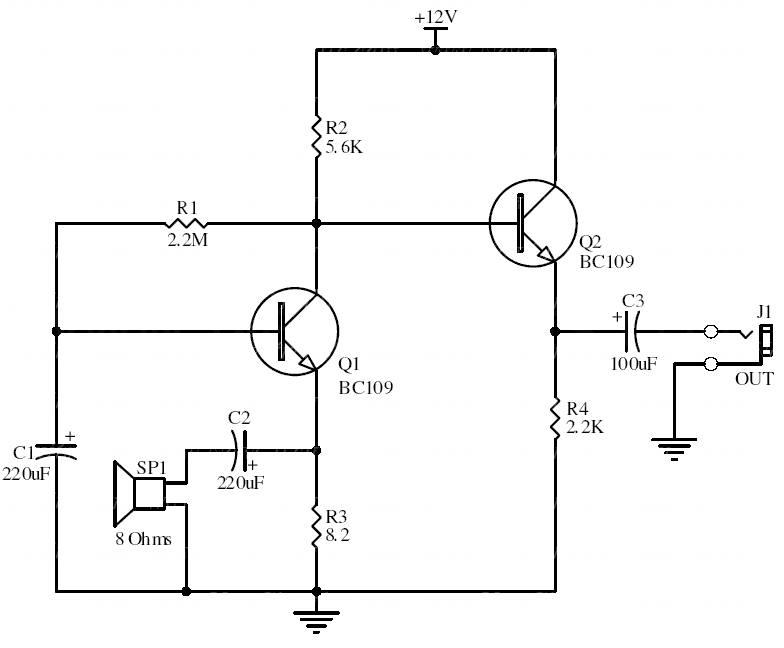
Moving the speaker cone moves its voice coil through a magnetic field and generates a small voltage. A common-base input stage accepts this low-impedance signal; a directly coupled emitter follower then lowers the output impedance for the following audio stage.
The original circuit specifies a 6–12 V DC supply and speakers from 4 Ω to 64 Ω. Its speech quality depends strongly on the speaker and is unlikely to match a purpose-built microphone.
Original schematic
CLICK TO ENLARGEOn the bench
The original notes suggest matching the 8.2 Ω resistor to the speaker impedance. Verify the bias conditions after any change, and compare sensitivity at a fixed distance from the speaker cone.
Resources & provenance
Rewritten from the original circuits/aum/lj3on1t_aum007.php page. Component values and historical performance claims have not been independently bench-tested. The circuit figures have had their watermarks removed.
Browse all surviving downloads →