How it works
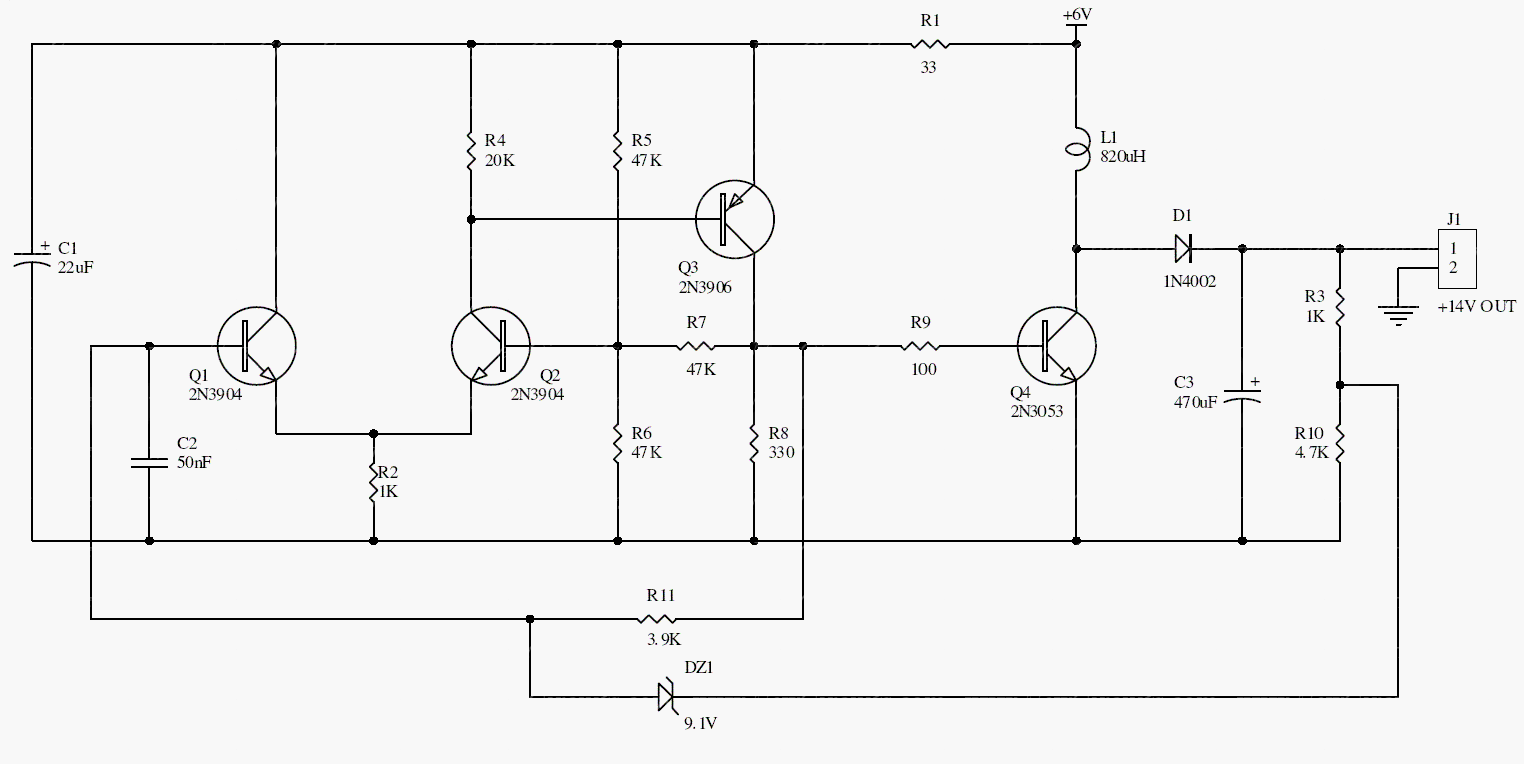
A Schmitt-trigger oscillator drives a transistor that stores energy in the inductor. When the transistor turns off, that energy transfers to the output. A zener-controlled feedback path stops oscillation when the output reaches the intended threshold.
The original notes describe roughly 14 V output and around 80% efficiency. Both depend on input voltage, inductor loss, switching behavior, and load; neither is established as a measured specification here.
Original schematic
CLICK TO ENLARGEOn the bench
Test with a current-limited source and a defined load. Check transistor and diode peak ratings, inductor saturation current, and output ripple before attaching sensitive electronics.
Resources & provenance
Rewritten from the original circuits/pos/h23n8m9_pos001.php page. Component values and historical performance claims have not been independently bench-tested. The circuit figures have had their watermarks removed.
Browse all surviving downloads →